If you’ve been anywhere near OOH or live events in the last two years, you’ve seen clips of the MSG Sphere in Las Vegas. People talk about it like a novelty (“cool LED ball”), but from a business angle it’s more useful to treat it as a case study in premium attention: what happens when a venue combines a record-scale screen, predictable foot traffic, and content that’s built to be filmed and shared.
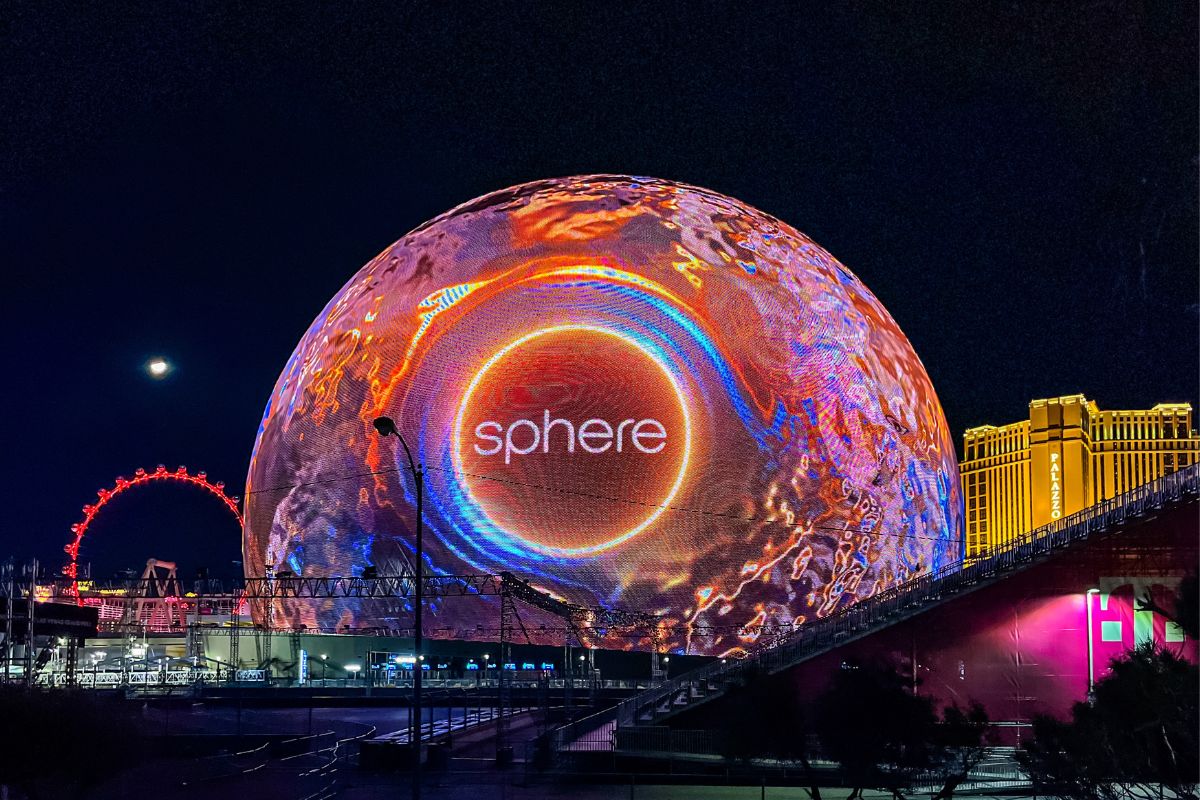
For anyone who owns (or wants to own) digital inventory—billboards, place-based screens, even retail façades—Sphere is a reminder that screen size alone doesn’t create value. Location geometry, content rules, operating discipline, and sales packaging are what turn pixels into profit.
Quick Sphere facts (so we’re talking about the same thing)
Sphere is roughly 366 feet tall and 516 feet wide at its broadest point. Populous
It has a wraparound interior LED display and a massive programmable exterior “Exosphere”. Sphere Entertainment has described the interior as 160,000 sq. ft. and 16K × 16K resolution, and the exterior as 580,000 sq. ft. Sphere Entertainment Co.+2Sphere Entertainment Co.+2
The exterior is also described as having about 1.2 million LED pucks. Sphere Entertainment Co.+1
Here’s a simple cheat sheet:
| Item | Why it matters to owners | What Sphere shows |
|---|---|---|
| Exterior LED “Exosphere” | Landmark inventory can behave like “earned media” | 580,000 sq. ft. fully programmable exterior canvas Sphere Entertainment Co. |
| Interior LED “movie screen” | Ticketed immersion is a different revenue model than OOH | 160,000 sq. ft. display plane; cited as 16K × 16K Sphere Entertainment Co.+1 |
| Physical scale | Big screens amplify both wow-factor and mistakes | 366 ft tall / 516 ft wide Populous+1 |
| Systems behind it | Reliability + synchronization become the product | NVIDIA notes ~150 RTX A6000 GPUs and synchronized playback NVIDIA Blog |
Why Sphere matters to billboard people (even if you’ll never build one)
Most billboard revenue is still built on two things: impressions and simplicity. Sphere adds a third lever: shareability.
Sphere’s exterior isn’t just “another screen.” It’s living architecture that gets filmed by tourists, reposted by media outlets, and used as a backdrop for major events. Sphere Entertainment explicitly positions the Exosphere as something brands can use to connect with audiences in new ways—and that it will be seen not just by people nearby, but through social sharing. Sphere Entertainment Co.
That’s the key business lesson: a screen that creates its own distribution can justify premium pricing—if you can package it correctly and keep performance consistent.
The “largest movie screen” question is really two questions
When people search “largest movie screen,” they often mash together:
-
Largest cinema screen (traditional projection, IMAX-type formats)
-
Largest LED display used for cinematic experiences (like Sphere’s interior)
Sphere’s interior is frequently described as a wraparound “movie screen” because it’s used for cinematic-style shows, not because it’s a conventional theater screen. If you want a clear explainer that frames this topic for buyers, this page is a decent starting point: Largest movie screen
What you should copy (and what you shouldn’t)
Most owners can’t copy Sphere’s scale, but you can copy the principles.
1) Control the primary viewing angle
Anamorphic 3D, giant façade takeovers, even basic motion ads all perform better when there’s a “main approach” where the creative reads cleanly. Sphere works as a landmark partly because the exterior content is designed to be legible from common sightlines and distances (Strip traffic, pedestrian corridors, resort approaches). Sphere Entertainment Co.
Owner takeaway: don’t sell your screen as “all angles.” Sell it as “this angle is unbeatable,” and enforce creative rules that protect it.
2) Treat content rules like a lease clause
Sphere’s visuals look expensive because they’re curated, not because LEDs are magic. In billboard terms: if you allow “anything goes” creative, your premium asset starts looking like a random screen at a strip mall.
Simple rules that protect premium inventory:
-
max words on screen
-
safe margins / no edge-hugging logos
-
motion limits (so it doesn’t turn into a blur)
-
brightness and contrast targets (so faces don’t wash out at noon)
3) Plan your operations like a utility company
At Sphere scale, a 1% failure is a headline. Even on a single digital board, downtime is the silent killer of renewals.
Sphere’s tech stack is designed around synchronized playback and reliability at extreme scale. NVIDIA Blog+1
You don’t need 150 GPUs, but you do need:
-
spare modules and power supplies on hand
-
calibration schedules
-
a clear SLA for repairs
-
remote monitoring (temperature, power, signal)
4) Package “premium” as a product, not a promise
Sphere can sell:
-
event takeovers
-
brand moments tied to major dates
-
content that becomes news (people talk about it)
Most digital billboard owners can do a smaller version:
-
category exclusivity (one auto brand per loop)
-
high-impact share of voice (first/last slot)
-
event bundles (sports weekends, festivals, holiday travel weeks)
A practical due-diligence checklist (before you chase “bigger screens”)
If you’re evaluating a major digital build—whether it’s a landmark façade, a mini “Sphere-style” dome in a venue, or just a premium urban digital board—run through these questions:
-
Where is the primary viewing corridor? (and what % of impressions come from it)
-
What’s the permitting reality? (brightness limits, motion rules, curfew rules, historic districts)
-
How will you enforce creative standards? (approval workflow, file specs, reject rules)
-
What’s your maintenance plan and spare parts plan? (not “we can order it,” but “we have it”)
-
What’s your true operating cost? (power, connectivity, lifts, service visits, insurance)
-
Who sells it—and how? (local direct, programmatic, national rep, hybrid)
-
What’s the premium story? (why this screen is worth more than the next one)
-
What’s the fail-safe plan? (if the screen goes down at the worst possible time)
Closing thought
Sphere didn’t win attention because it’s big. It won because it’s big + located correctly + operated tightly + fed with content designed for the medium.
If you’re building or upgrading digital inventory, that’s the mindset worth borrowing. “Largest” makes headlines, but repeatable revenue comes from the boring stuff: sightlines, rules, uptime, and sales packaging.